Showing posts with label map. Show all posts

Wednesday, October 28, 2009

Rah-e-Nejat Update


I have compiled a basic map showing Operation Rah-e-Nejat (click for larger version). Green icons indicate cities held by the Pakistani Army and black icons those held by the Taliban. The three red lines are the three "axes" referred to in news reports: the Razmak-Makin Axis, the Shakai-Kaniguram Axis, and the Jandola-Sararogha Axis. Note that while Kaniguram is still held by the Taliban, it has been surrounded by Pakistani forces and will probably soon fall.

Saturday, January 31, 2009

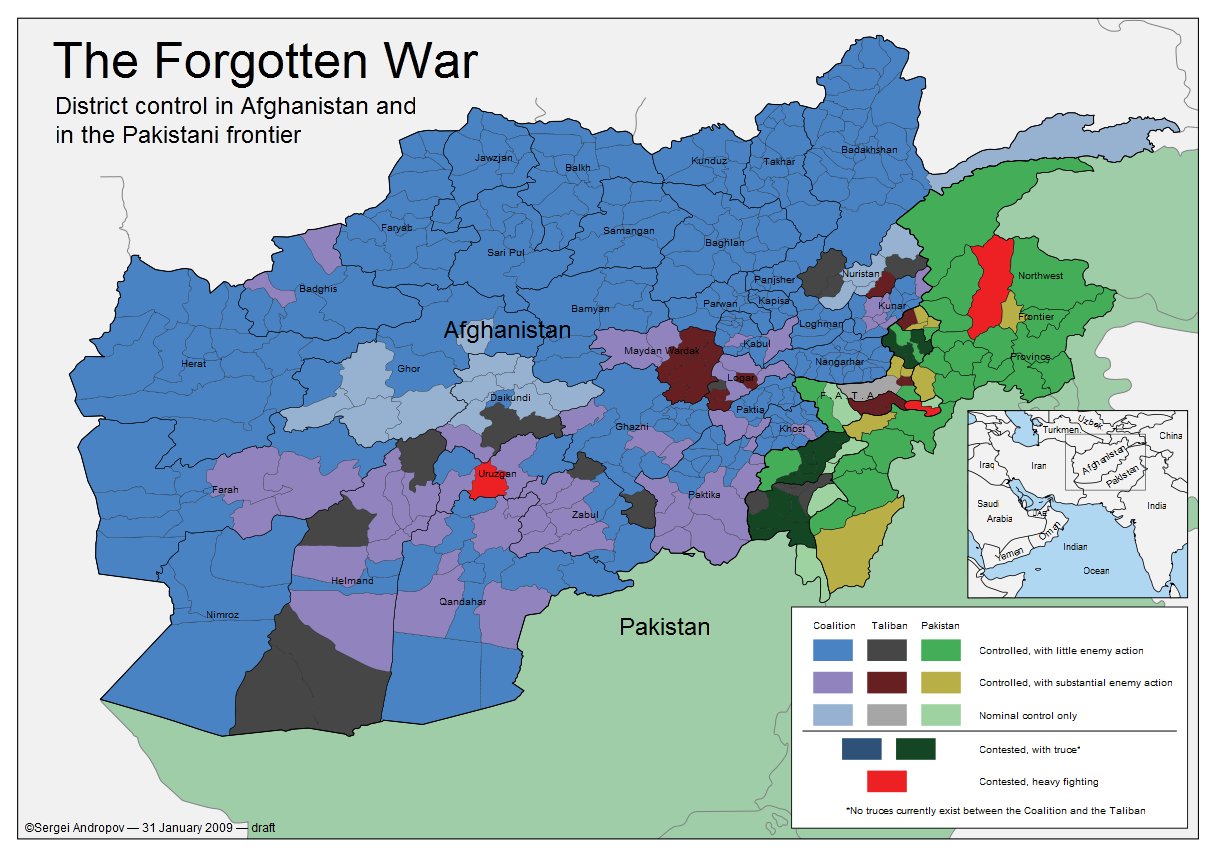
Map update

31-01-09

The Pakistani government claims to have regained control of a number of areas. I'm somewhat skeptical of this, and indicated the government's claims only as much as is tactically reasonable.

Progress is slowly being made in Swat, with the capital city of Mingora being retaken recently.

Ghazni is still out of date, and I want to check Loghman and Kapisa as well. My complete district level base map of Pakistan is nearing completion; I'll include it while I work on the individual tehsils (Pakistani tehsil ≈ Afghan district).

Wednesday, January 21, 2009

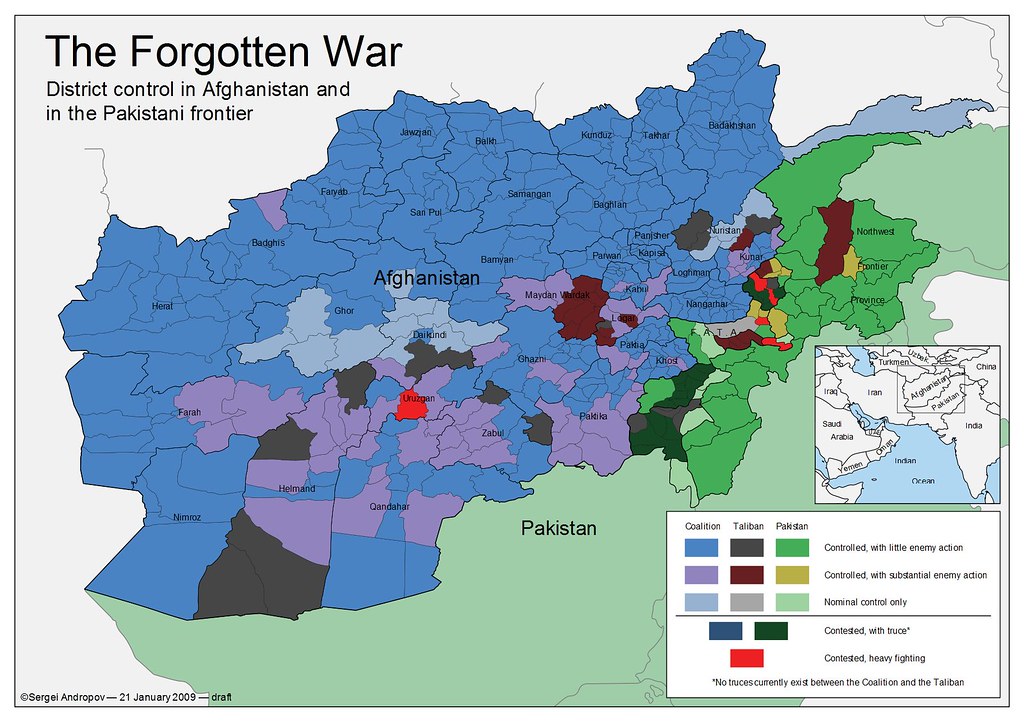
Map update

21-01-09

NATO has launched an offensive in the Baluchi Valley, and Pakistan has launched one in Mohmand Agency. I'm currently working on showing the districts in the rest of Pakistan. Ghazni still needs to be updated.

Also, what will hopefully be my final semester at Berkeley has begun.

Saturday, January 10, 2009

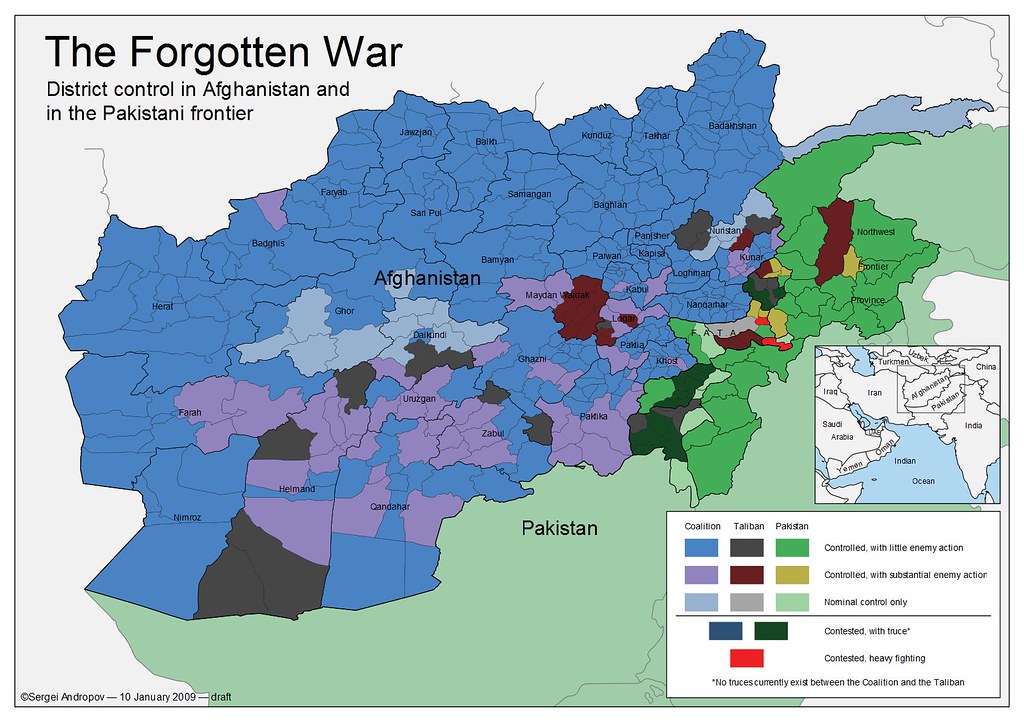
Map update

10 January 2009

Still some updating left to do, especially in Ghazni. Additionally, the fighting in Bajaur has gone down due to Pakistani troops being redeployed to the border with India.

Friday, January 2, 2009

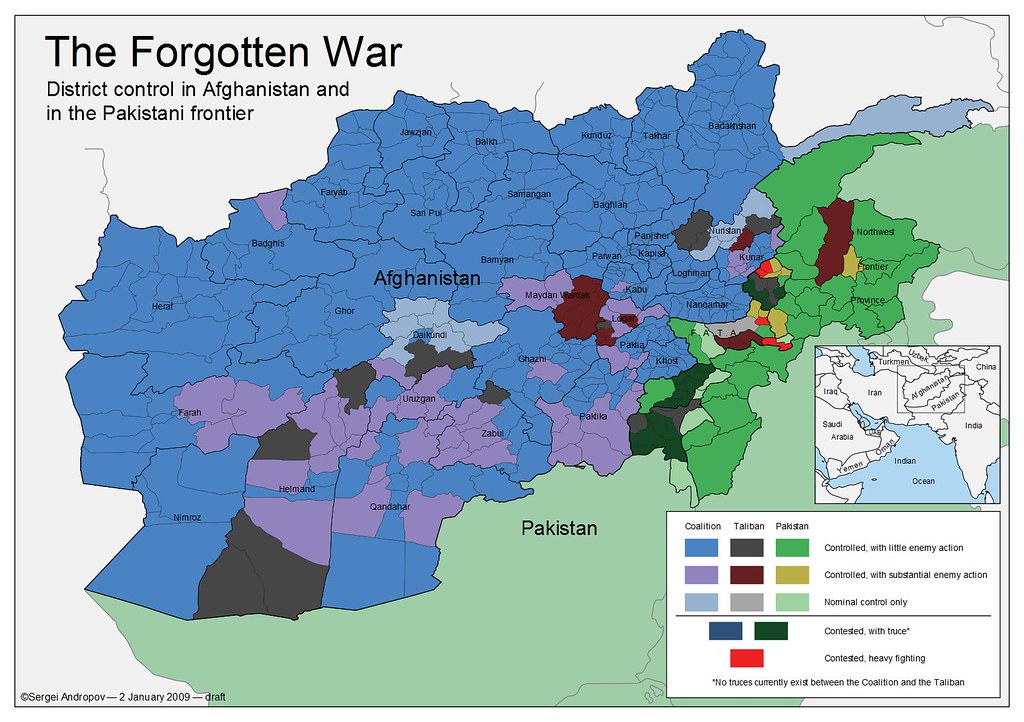
Map update


Because I had been spending so much time on the map itself (along with other school things), it seems I let my data get pretty badly out of date. This version has been corrected to account for the falls of Logar and Wardak provinces, with a few other corrections. Note, though, that it is still not completely up to date.

Thursday, December 11, 2008

Look on my works ye mighty and despair!

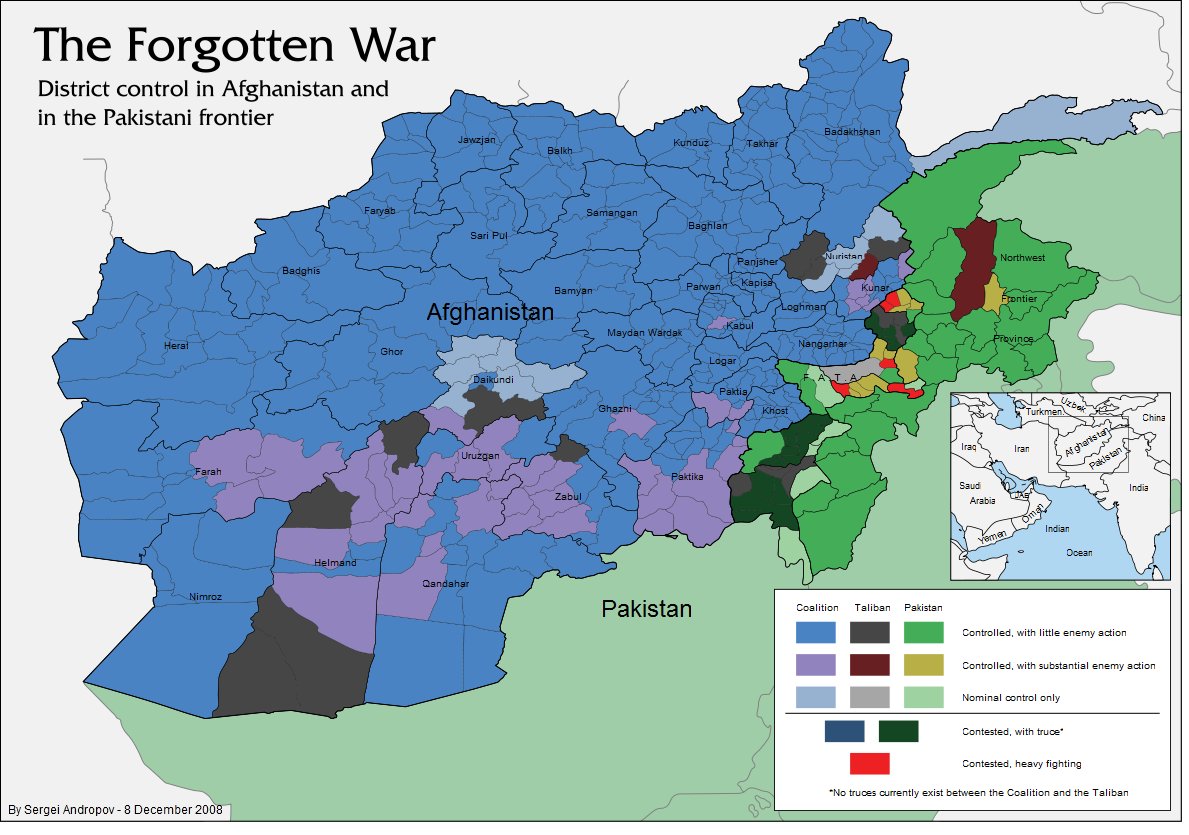
TFW 8 December 2008


(Click for full size image.)

At long last, Tʜᴇ Mᴀᴘ is complete.

Due to the narrow width of Blogger's columns, I'm almost certainly going to have to migrate to WordPress.

Thursday, December 4, 2008

Crunch time

Sorry for the extreme dearth of posts; this is end of the semester crunch time. I'm working pretty much full time on my cartography final project, which is to be the first of the long awaited Afghanistan maps for this site.

Friday, November 7, 2008

'US missiles' hit Pakistan village

A suspected US drone has launched a missile strike into northwest Pakistan, reportedly killing at least 10 people.

The attack on Friday targeted a town in North Waziristan, a tribal region on the Afghan border, security officials said.

"It happened close to the border," a Pakistani military officer said.

"We have reports of 10 dead but it will take time to get more information."

The North Waziristan region is a reputed stronghold of the Taliban and al-Qaeda linked fighters.

Other Pakistani officials told the AFP news agency that up to 14 fighters were killed when the missile strike destroyed an al-Qaeda training camp.

Four missiles

Four missiles are thought to have been fired at the camp, in Kum Sham village, some 35km south of Miranshah in North Waziristan.

Security sources said the village is dominated by Wazir tribes and is near the border with South Waziristan, another hub of Taliban and Al-Qaeda operatives.

"Between 11 to 14 militants, mainly foreigners, were killed in the strike," a senior military official said.

It was not immediately clear if there were any high-value targets among those killed, sources said.

An intelligence official, also speaking on condition of anonymity, said: "The strike successfully destroyed the camp."

Al Jazeera's Kamal Hyder, speaking from the Pakistani capital Islamabad, said: "At the moment we are being told by sources in the area that the attack took place in the Razmak village [of North Waziristan].

"We are told that up to 17 people were also wounded in this attack.

"Just a few days ago we were in this region. And we were able to observe that even at nighttime the drones have been flying over this area.

"It has also causing considerable anger in that region because the Pakistani military forces have been deployed in very large numbers along this border and every time there is a strike deep into Pakistan it creates more public resentment. Not just against the Americans but also the local forces which are not able to stop these attacks.

"In spite of opposition by the Pakistani government, the Americans have been buzzing the Pakistani tribal territories ... and they have been picking out targets with impunity."

Sovereignity violated

At least 18 such attacks by unmanned US aircraft have occured since September.

However, this is the first since General David Petraeus, the US Central Command chief, took charge of the war in Afghanistan.

[More]


Comment:

I had been hoping that Petraeus would put an immediate end to the strikes, but I guess not. At least no civilians were killed this time.

In map-related news, I have finally found Tehsil-level maps of FATA. They turned out to be hiding in the 1998 Pakistani Census, which UC Berkeley has a copy of. This means that I can at last begin work on the base map.

Monday, October 6, 2008

Pakistan tribes attack Taliban

Tribal volunteers in Pakistan have threatened to destroy the house of Maulvi Omar, a senior Pakistani Taliban spokesman, in the north of the country.

The volunteers surrounded Omar's house on Monday and also said that the homes of other Taliban supporters would be targeted.

The threats are part of a crackdown on the Taliban some tribes people are launching in the Bajaur Agency.

The volunteers' commander says they have 20,000 men ready to carry out the campaign and that they are not asking for any government help.

Kamal Hyder, Al Jazeera's correspondent in Islamabad, said that a military operation in Bajaur had made it the scene of heavy fighting and displaced tens of thousands of people from the area.

"[This] caused considerable anger at both the, so called, Taliban in the region for destabilising the region, and the military coming.

"That disillusionment now seems to have turned against the fighters who have been fighting the military."

Hyder said that the locals have been burning the houses of senior commanders who have allied themselves to the Taliban and surrounded the house of Omar.

"There was some desperate attempts by the pro-Taliban elements to try and prevent the destruction of Maulvi Omar's house, but the tribals have said that they will go ahead anyway."

However, Hyder said that Afghan refugees and some Afghan commanders in the area were still attempting to resist the tribal volunteers.

Rocket attack

The attacks came a day after opposition fighters fired rockets at the home of a politician in Pakistan's North West Frontier Province, bordering Afghanistan.

Two rockets damaged three homes in the town of Marden on Sunday.

The rockets failed to hit the home of Amir Haider Khan Hoti, the North West Frontier Province's chief minister and the intended target.

No one was injured in the attack. Hoti was said to be in Peshwar, the provincial capital, at the time.

Mian Iftikhar Hussain, the provincial information minister, said: "We expect more such incidents."

"They are not going to be stopped here. We are facing a war-like situation."

The strike followed a number of attacks targeting politicians in the lawless border area.

A suicide bomber detonated a bomb outside the house of a leading pro-government politician last week, killing four people.

Via Al Jazeera.


Comment:

This is only one example of a number of tribal activities currently underway against the Taliban.

In other news, I have finally found highly detailed maps of the border region, which I am working on integrating into a single very high quality reference map.

Sunday, August 31, 2008

Pakistan halts fighting for Ramadan

Pakistan has announced a suspension of military operations against fighters in the tribal regions during the month of Ramadan, the Muslim holy month of fasting.

But a senior official said on Saturday that security forces would respond if attacked.

Rehman Malik, an interior ministry official, said that security forces would suspend operations from Sunday night for the month of Ramadan, which ends at the beginning of October.

"If militants take any action the security forces will respond with full force," Malik told reporters in the eastern city of Lahore.

"It is not a ceasefire," he stressed, "if they fire a single bullet we will respond with 10 bullets."

Military campaign

Violence has intensified in Pakistan in recent weeks with the military battling armed groups in three different parts of the country's northwest.

Troops backed by helicopter gunships and heavy artillery have for weeks been pounding what they say are pro-Taliban and al-Qaeda strongholds in the area, killing more than 560 people, according to officials.

The US says that al-Qaeda and Taliban fighters are based in sanctuaries in northwest Pakistan's ethnic Pashtun tribal areas on the Afghan border.

The suspension of military operations comes a day after Pakistan's army said it had killed 40 fighters in an air strike that targeted a rebel stronghold in the country's Swat region.

Deteriorating security in Pakistan has coincided with a faltering economy and political upheaval, with the resignation of Pervez Musharraf, Pakistan's president, last week.

That was quickly followed by a split in the ruling coalition.

Via Al Jazeera.


Comment:

Hopefully the Taliban will pause the fighting, but I doubt it.

In other news, I have recently begun a course on cartography, so my eternal dream of having a good map depicting the current situation in Afghanistan at a glance will hopefully become a reality.

Sunday, July 27, 2008

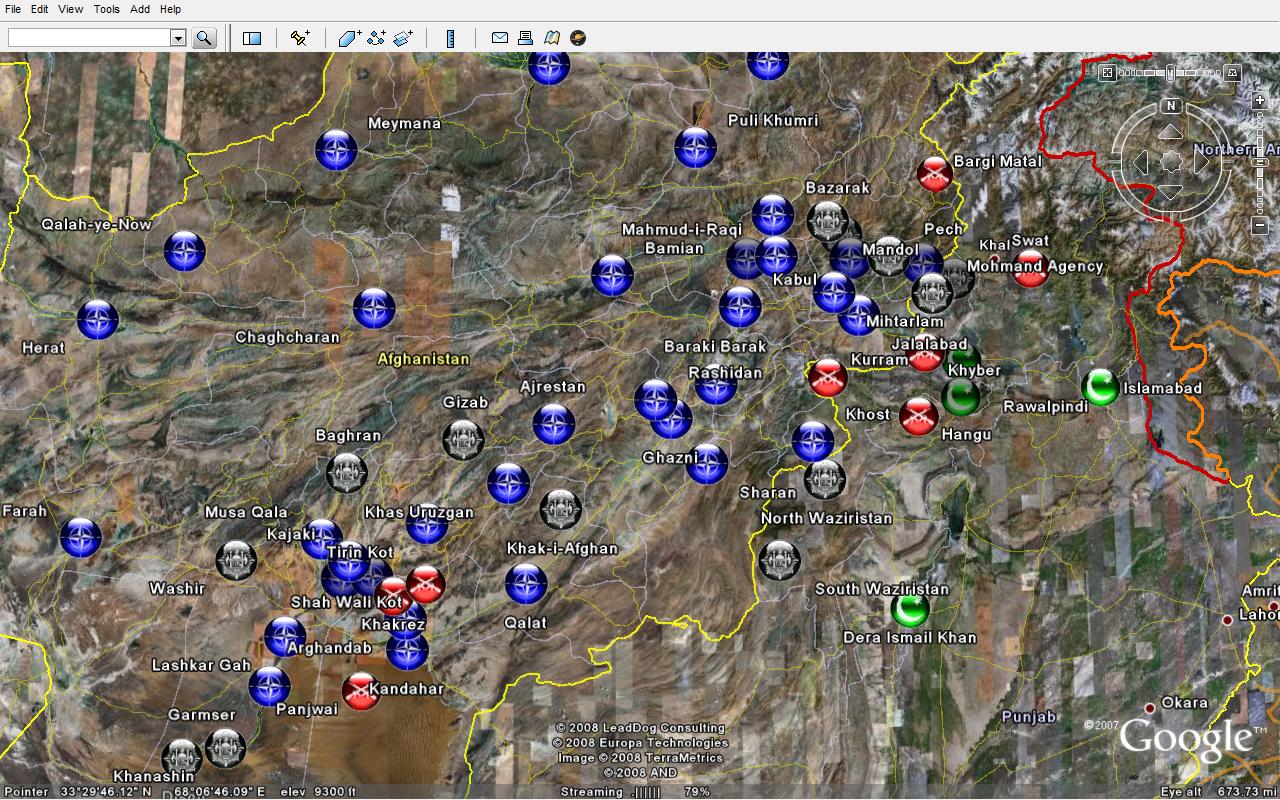
Tʜᴇ Mᴀᴘ: Rough Draft

Finally.

This is a provisional map of who controls which districts in Afghanistan, as of 26 July 2008. The blue icons indicate control by NATO, the United States, and/or the central Afghan government. In order to avoid clutter (and crashing Google Earth), not all of these districts are shown; those that are shown are typically provincial capitals (especially those with Provincial Reconstruction Teams) or districts that the Taliban had controlled in the past. The black icons indicate districts and (and tribal agencies) held by the either the Islamic Emirate of Afghanistan itself or the closely related Tehreek-e-Taliban-e-Pakistan. This set is to the best of my knowledge complete, but bear in mind that this map is a rough draft. The green icons indicate districts and agencies that are held by Pakistan; obviously most such districts are not marked. The red icons indicate districts and agencies that are contested.

For the main image page on Flickr, click here.

Saturday, September 1, 2007

Progress is being made


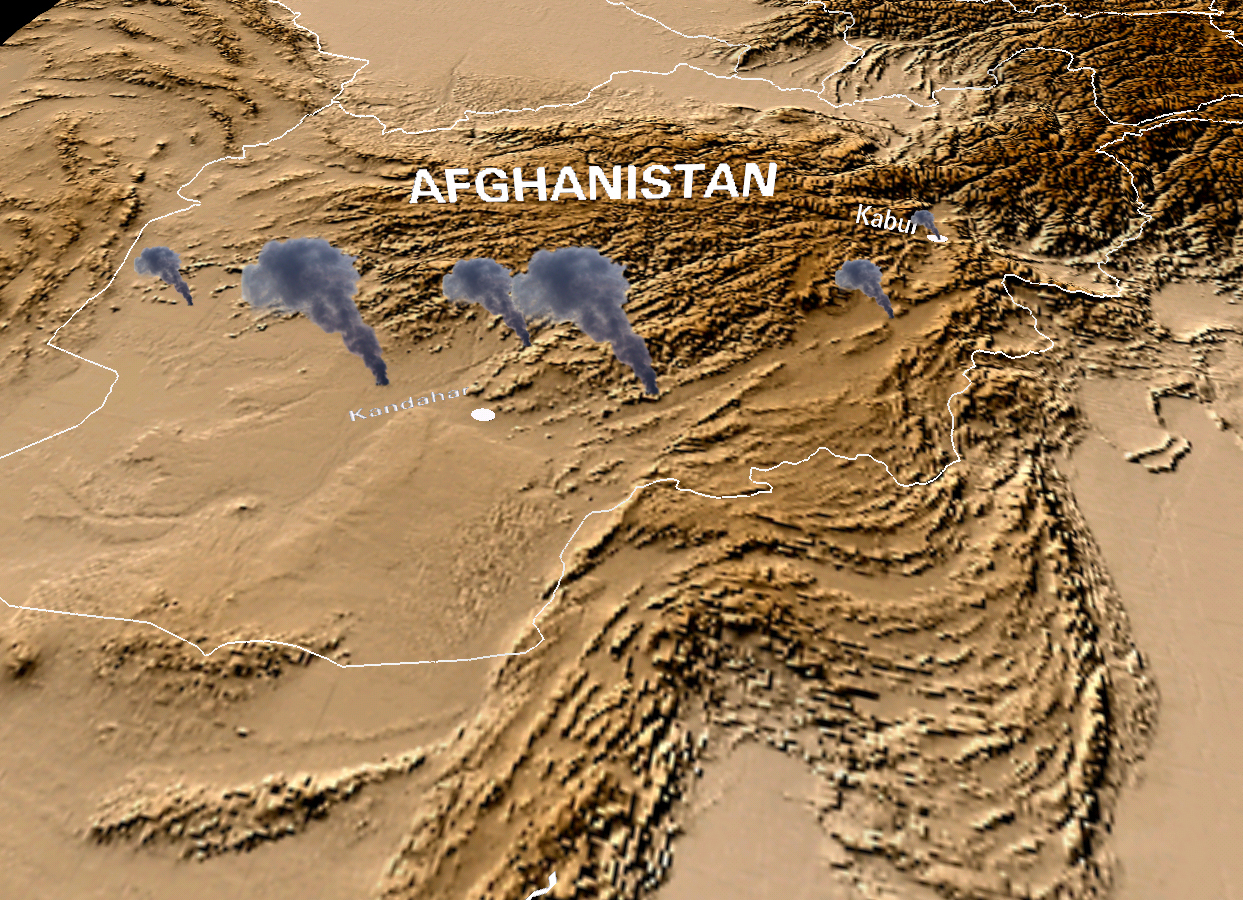
As those of you who have been following this blog for some time know, it has long been an objective of mine to provide maps showing the various incidents in Afghanistan. I am pleased to report that significant progress towards this goal has been made, and I have successfully created a rudimentary base map of the region, as shown above. Now all that needs to be done is devising a way to depict the incidents themselves, and I have been making progress here, too (although not as much).

The above image was produced with the Maya Personal Learning Edition using NASA's Blue Marble satellite imagery and data from the same agency's World Wind DEM.

Monday, April 30, 2007

US: More than 130 Taliban killed

The US-led coalition has said its troops have killed more than 130 Taliban fighters in Afghanistan over the past several days. The fighters were killed in two separate battles in the western province of Herat, the US military said in a statement on Monday, suffering their heaviest losses this year.

Herat, bordering Iran, had been relatively safe until recently compared with the south and east, where the Taliban are most active. [More]


Comment:

Soon, I hope, I'll be able to report incidents like this on the now semi-mythological map. I've made something of a breakthrough with it, and hope to have it up and running soon.


Tuesday, April 3, 2007

Map update

I've decided that I'm going to use two different smoke columns to differentiate between "victory" and "defeat". The white column (which I have yet to make) will indicate incidents that are generally favorable to the government/ISAF, such as successful military operations, the Pashtun's campaign against the Uzbek militants, etc. The existing black column will show incidents favorable to the Taliban/al-Qaeda, such as successful ambushes, assassinations, civilians killed by US fire, etc. I'll also probably make a grey column for ambiguous cases.

The tricky thing here is providing enough information to be useful, but not so much that people are overwhelmed. My goal is not to simply amass as much information on the War on Terror as possible, but to enable regular people to keep abreast of it without having to slog through endless repetitive articles first.


The Forgotten War. We slog. You decide.


Edit: I'm also going to try to flesh out the other areas of this site. I'm planing on doing an editorial on the Zawahri plan and/or al-Qaeda's nuanced and ephemeral hierarchy. I'm also going to add a page containing various important documents, such as the intercepted Zawahri-Zarqawi letter.

Friday, March 30, 2007

Sample map


This is an incomplete incident map for week 288 of the War on Terror. As it is right now it's too ambiguous, so I'm trying to come up with a way to show if each incident represents a "victory" or a "defeat". I'm also going to switch to a more detailed map, and meddle with the transparency levels of the smoke some more. Thoughts?