Pakistani jets bomb S Waziristan
Pakistani aircraft have attacked suspected Taliban fighters in South Waziristan near the Afghan border, in advance of an imminent ground assault.
The air raids on Sunday night came less than 24 hours after commandos stormed an office building and rescued dozens of security officials taken captive after an attack on the general army headquarters in Rawalpindi.
"The jets hit and destroyed two of their hideouts in Makeen and Ladha and we have a total of about 16 militants killed," a unnamed Pakistani intelligence official told Reuters news agency.
But the military has been conducting air and artillery strikes in South Waziristan for months, while moving troops, blockading the region and trying to split armed opposition to Islamabad's authority.
However, a ground offensive has yet to begin and may prove to be the army's toughest test since fighters turned on the state.
Imminent attack
Nevertheless, Rehman Malik, the interior minister, in an interview in Singapore said a ground offensive was "imminent".
"There is no mercy for them because our determination and resolve is to flush them out," he said.
"They have no room in Pakistan, I promise you."
Malik said members of the Pakistani Taliban and al-Qaeda were suspected to have been behind Saturday's attack on army headquarters, which ended a week when suicide bombers struck in the capital Islamabad and Peshawar, killing more than 50 people.
He also said the offensive against the fighters in South Waziristan was no longer a matter of choice.
"It is not an issue of commitment, it is becoming a compulsion because there was an appeal from the local tribes that we should do the operation," Malik said.
Provincial links
In an interview with Al Jazeera, Imtiaz Gul, a political analyst, said he agreed that the government was correct to commence an offensive against South Waziristan.
"A lot of al-Qaeda and ideologically tainted people belonging to the Islamic movement of Uzbekistan under the patronage of the Taliban are sheltering there," he said.
But not everyone agrees. Zafar Jaspal, a Pakistani analyst, believes that Islamabad has concentrated too much on the Swat valley and South Waziristan.
"Till today, the government has no clear strategy on how to deal with the militants who are residing in southern Punjab," he told Al Jazeera.
"The person who was captured alive after [the GHQ attack] comes from Punjab, and other members of that group are also from Punjab ... certainly the government needs to have a parallel strategy - for Punjab as well as South Waziristan."
Al Jazeera
Comment:
And so it begins.
This is not quite the final push — Orakzai is still in the Taliban's hands — but it might as well be. Once Waziristan has been won, the fate of the Pakistani Taliban will have been sealed. Most surviving militants will probably flee into Afghanistan, in a remarkable mirroring of the events eight years ago. This time, though, the US military will be there to meet them. The tactical imperative of increasing the number of troops in eastern Afghanistan is more clear now than ever: a Taliban surge is coming, and there must be an American surge to counter it.
Showing posts with label Taliban. Show all posts
Showing posts with label Taliban. Show all posts
Sunday, October 11, 2009

Friday, June 12, 2009
Pakistan 'expands war on Taliban'
Pakistan's military is beginning a significant move into South Waziristan, where the
Tehrik-e-Taliban Pakistan - or the Pakistani Taliban - are based, US officials have said.
The operation is said to be targeting Baitullah Mehsud, the leader of the Pakistani Taliban, and will be carried out with greater support from the US.
Witnesses and intelligence officials said Pakistani aircraft had bombed a stronghold of Baitullah Mehsud on Saturday, the Pakistani Taliban leader, in the South Waziristan.
"Four fighter jets bombed parts of Makken early on Saturday but we don't know about the extent of damage or any casualties," Mohammad Khan, a shopkeeper in the area said.
Pakistan's Geo TV reported that large numbers of people were migrating from South Waziristan to North Waziristan.
"Operations that appear to be under way now would be the largest operations that have been undertaken in Waziristan," a US defence official said on Friday.
"We think that the initial phases of that operation have already begun."
Pakistan says it has almost completed an offensive to drive Taliban fighters out of the Swat Valley, an area to the north of Waziristan in North West Frontier Province (NWFP).
Fight 'to the end'
Asif Ali Zardari, the Pakistani president, said on Saturday he would fight the Pakistani Taliban "to the end".
"We are fighting a war for our sovereignty. We will continue this war until the end, and we will win it at any cost," he said.
"These people want to capture the institutions of Pakistan by spreading terrorism and by intimidating the people.
"They have killed thousands of innocent people."
Zardari's comments came after two suicide bomb attacks on Friday, claimed by the Pakistani Taliban, in Lahore and Nowshera, in NWFP, killed at least eight people, including a pro-government religious leader.
Maulana Sarfraz Naeemi, known to oppose the Taliban, had condemned the use of suicide bombings.
The US defence official said on Friday that the Pentagon expected Pakistan to conduct "fairly significant combat operations in South Waziristan".
Another US official said Taliban and al-Qaeda leaders were "under very significant pressure", while a third US official said the US would be providing increased intelligence and surveillance support to Pakistan.
Taliban 'resistance'
Pakistan's recent operations have been under way for six weeks, taking the military first into Buner and Upper Dir districts, then into the Swat Valley.
The first US official warned that "isolated pockets of resistance still remain" in parts of the Swat valley as the Pakistani army worked to finish the two-month campaign, and that Islamabad needed to brace for more attacks.
"[Mehsud] has turned suicide bombing into a production output not unlike Toyota outputs cars," the official, who described the Mehsud as leading an extensive network of religious schools that sold or bartered child suicide bombers in NWFP, said.
The key element of the US Afghanistan-Pakistan strategy, the defence official said, is to have troops put pressure on al-Qaea and Taliban fighters believed to be operating out of safe havens in Waziristan.
From Al Jazeera.
Comment:
First a president was elected who is extremely popular in the Muslim world, then that president gave a speech that surpassed their wildest hopes, then al-Qaeda announced that it's broke, and now Pakistan has finally, at long last, taken the fight against the Islamic Emirate of Waziristan and its allies to Waziristan itself. Meanwhile, troops and development projects pour into Afghanistan, and public opinion in Pakistan turns against the TTP.
Could this be the beginning of the end?
Thursday, December 11, 2008
Look on my works ye mighty and despair!
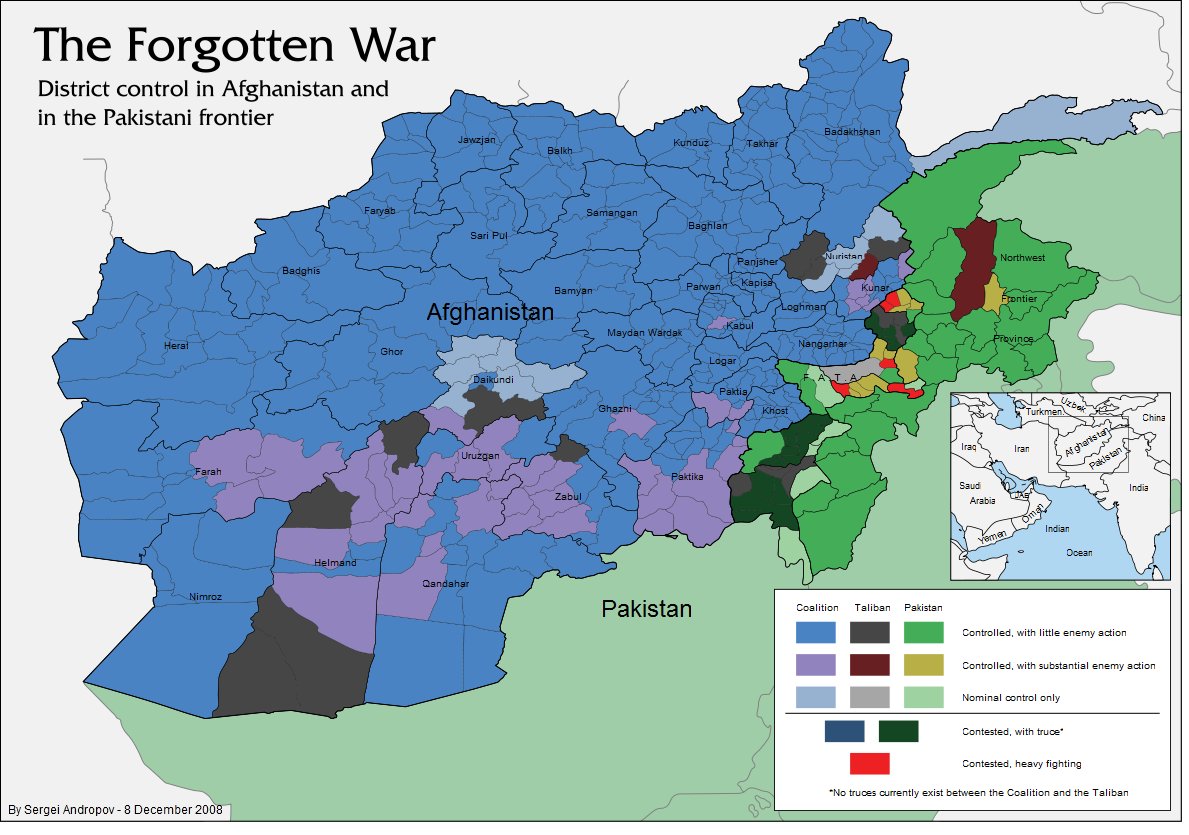
(Click for full size image.)
At long last, Tʜᴇ Mᴀᴘ is complete.
Due to the narrow width of Blogger's columns, I'm almost certainly going to have to migrate to WordPress.
Tuesday, November 25, 2008
Karzai urges Afghan war timeline
Afghan President Hamid Karzai has called for a timetable for ending the war against the Taleban in his country.
Mr Karzai made the call in a speech to a visiting UN Security Council team.
He said if Afghans had "no light at the end of the tunnel" they had the right to pursue other options, such as peace negotiations with the Taleban.
Mr Karzai also demanded an end to arrests of Afghans "in their homes, in the roads" by international forces, saying it was the job of Afghan police.
[snip]
Mr Karzai said there were two options.
First would be to set a timeline, saying that what had not been achieved in the past seven years would be achieved in the next "four years, five years or another seven years".
But he added: "If we cannot give a light at the end of the tunnel to the Afghan people, [do] the Afghan people have a right to ask for negotiation for peace? [Do] the Afghan people have a right to seek other avenues?"
Mr Karzai said he would continue to fight al-Qaeda and Taleban members "who are ideologically against the rest of the world".
However, he said Taleban members who were "part of the Afghan community" could be brought back to serve Afghanistan.
[More]
Comment:
That last part is the crux of the matter. Karzai has been (rightly) calling for negotiation with the reconcilables for quite some time now — indeed, he has actually engaged in some negotiation with the mediation of King Abdullah. His borrowing of the words "timeline" and "withdrawal" from Iraq is blatant electioneering, and nothing more.
The fact that he felt it would be beneficial to say it, however, is emblematic of a real problem, which is that we are running out of time. The good will of the Afghan people cannot last forever, and it is beginning to wear thin.
Mr Karzai made the call in a speech to a visiting UN Security Council team.
He said if Afghans had "no light at the end of the tunnel" they had the right to pursue other options, such as peace negotiations with the Taleban.
Mr Karzai also demanded an end to arrests of Afghans "in their homes, in the roads" by international forces, saying it was the job of Afghan police.
[snip]
Mr Karzai said there were two options.
First would be to set a timeline, saying that what had not been achieved in the past seven years would be achieved in the next "four years, five years or another seven years".
But he added: "If we cannot give a light at the end of the tunnel to the Afghan people, [do] the Afghan people have a right to ask for negotiation for peace? [Do] the Afghan people have a right to seek other avenues?"
Mr Karzai said he would continue to fight al-Qaeda and Taleban members "who are ideologically against the rest of the world".
However, he said Taleban members who were "part of the Afghan community" could be brought back to serve Afghanistan.
[More]
Comment:
That last part is the crux of the matter. Karzai has been (rightly) calling for negotiation with the reconcilables for quite some time now — indeed, he has actually engaged in some negotiation with the mediation of King Abdullah. His borrowing of the words "timeline" and "withdrawal" from Iraq is blatant electioneering, and nothing more.
The fact that he felt it would be beneficial to say it, however, is emblematic of a real problem, which is that we are running out of time. The good will of the Afghan people cannot last forever, and it is beginning to wear thin.
Thursday, November 13, 2008
Captured battle plan shows strength and training of Taleban forces
The map tells a war story of its own. Sketched by a Taleban commander, it is of a stretch of territory fought over in Bajaur between the Pakistani Army and the insurgents. The ground has been neatly divided into specific areas of responsibility for different Taleban units.
Weapons caches, assembly areas and rendezvous points have been carefully marked and coded. This is not the work of a renegade gunman resistant to central authority; it is the assessment of a skilled and experienced fighter, and begins to explain how more than 400 Pakistani soldiers have been killed or wounded since August in Bajaur, the tribal district agency that is said to be the haunt of Osama bin Laden and his deputy, Ayman al-Zawahiri.
Discovered along with the map in a series of recently captured tunnel complexes are other documents - radio frequency lists, guerrilla warfare manuals, students' notes, jihadist propaganda and bombmaking instructions - that provide further evidence of the Taleban's organisation and training. They prove that the Taleban in Bajaur, one of Pakistan's seven Federally Administered Tribal Areas (Fata), were planning not only to fight, but also to disseminate their fighting knowledge.
“They were training people here,” Colonel Javed Baluch, whose troops seized the village of Tang Khata in an early stage of the autumn fighting, said, as he thumbed through the captured literature. “This was one of their centres. There were students here taking notes on bombmaking and guerrilla warfare. They were well trained and well organised.”
But training whom and to do what? Despite the documentary evidence in Bajaur, the Taleban's ultimate aims - and the nature of their relationship with al-Qaeda - remain contentious issues.
America and Britain claim that the terrorist network and affiliated organisations are being hosted by the Taleban in the tribal areas, which they use as a base for training camps, refuge and recruitment. This, they say, extends the threat from the tribal agencies to the rest of the world.
“If I were going to pick the next attack to hit the United States, it would come out of Fata,” Admiral Mike Mullen, chairman of the US Joint Chiefs of Staff, said recently. A Western diplomat in Islamabad claimed last month that among those killed by a Predator drone strike in the tribal area - there have been at least 18 drone attacks there in the past 12 weeks - were members of a terrorist cell planning an attack on Britain.
One eminent Pakistani political figure, speaking on condition of anonymity, claimed that al-Qaeda and the Taleban had set up a joint headquarters in 2004 as an “Islamic emirate” in North Waziristan, headed by Sirajuddin Haqqani, an Afghan Taleban commander. (His father, Jalaluddin Haqqani, a veteran of the fight against the Soviet Union, was funded by the CIA 30 years ago and was once fêted at the White House by Ronald Reagan.)
“Sirajuddin ... connects the Taleban with al-Qaeda and the Pakistani Taleban with the Afghan Taleban,” the source said. “It basically runs the war and has made Fata today the same as Afghanistan was before September 11 - controlled by foreign and local militants who fight a war on both sides of the border.”
Such claims, which have been circulated widely in Pakistan, are denied strongly by the military. Many officers describe the Taleban in Fata as a disparate group of home-grown militants with little vision beyond the affairs of their own district, and claim that al-Qaeda's involvement is negligible.
“There was an al-Qaeda presence here but it didn't include their training bases or headquarters,” Colonel Nauman Saeed, commander of the Frontier Corps garrison in Khar, Bajaur's capital, said. “They [al-Qaeda] were as a pinch of salt in the flour.”
General Tariq Khan, the officer commanding the Bajaur operation, said: “I do not see a coherent stategy in any of these militants. I don't see any Islamic movement of Waziristan or an Islamic emirate ... I think that everyone is in it for himself.”
The Pakistani military claims to have killed more than 1,500 insurgents in Bajaur, and General Khan admits that many foreign fighters - “Uzbeks, Chechens, Turkmen, some Afghans” - have been among them. Of al-Qaeda's top leadership, however, not a trace has been found. “We've hit some Arab leadership there but not of a very high level,” he said.
It could be that the leaders have withdrawn to the two valley strongholds still held by the Taleban in Bajaur, or that they have escaped to Afghanistan or to a neighbouring tribal area.
Or were they ever in Bajaur at all? Shafirullah Khan is the savvy political agent in the area, himself a Pashtun and a long-term veteran of tribal affairs. “At first I would never have believed that al-Zawahiri was here,” he said of the rumours that bin Laden's deputy had been a visitor.
“But now that I have seen those tunnels and hidden shelters, I am not so sure.”
Via the Times.
Friday, October 17, 2008
More propaganda
"Afghan mayor turns Taliban leader," announces Al Jazeera's top headline. But the man in question had not been mayor since the Taliban came to power, and had defected well over a year ago after being fired from his job as head of Herat's Department of Public Works. This story is not news by any stretch of the imagination, yet Al Jazeera considered it to be more important than the current financial Armageddon the planet is facing. I am apalled at this recent spate of pro-Taliban articles, and am very seriously considering finding somewhere else to get my news.
In other news, Hekmatyar has indicated that he would not be averse to switching sides (something he has a great deal of experience with), and the TTP is saying "uncle." I doubt that anything will come of the first (though I wouldn't put it past him), but it will be interesting to see what, if anything, will come of the second, especially inasmuch as the tribes are concerned.
In other news, Hekmatyar has indicated that he would not be averse to switching sides (something he has a great deal of experience with), and the TTP is saying "uncle." I doubt that anything will come of the first (though I wouldn't put it past him), but it will be interesting to see what, if anything, will come of the second, especially inasmuch as the tribes are concerned.
Sunday, October 12, 2008
We gain one, we lose one.
There's a lot to talk about today, so I'm going to depart from my usual format.
According to Al Jazeera:
Although I was somewhat disappointed to learn that there had been a district that I had not known was held by the Taliban, this is of course good news, as is the news, also reported in the article, that NATO had repulsed a major attack on Lashkar Gah. However, AJ did not mention this somewhat less cheerful development, which I found out about via Quqnoos:
The situation in Nuristan has been growing increasingly worrying. According to my current map prototype, the Taliban currently controls three of its eight districts, as well as the Dara-ye Pech District just across the border in Kunar Province, and a fourth district, Bargomatal, was attacked by Tehrik-i-Taliban-i-Pakistan back in July. I still have been unable to determine the outcome of that battle, but am inclined to think that, even if the TTP did manage to take it, which I don't think they did, their forces have since been withdrawn to fight the Pakistani security forces in Bajaur, which would leave the district only nominally in the Taliban's hands, just as so much of the rest of the province is only nominally in the hands of NATO and the central government. I have seen reports that some of the forces currently fighting in Bajaur had previously been fighting in Afghanistan, which lends some credence to this theory.
Nuristan, for those of you who are not familiar with it (i.e. pretty much all of you), is one of the most isolated inhabited regions on the face of the Earth. Its terrain is nearly impassable, and it is so out of the way that Islam didn't reach it until the end of the 19th century. Before then it was known as Kafiristan (land of the unbelievers) and its inhabitants as the Red Kafirs; their cousins, the Black Kafirs, or Kalasha, live on the Pakistani side of the Durand line and still practice their age-old pagan religion. The Nuristanis speak languages that are unusual even for Mianistan; while most languages in the region are either Iranian (e.g. Pashto, Wakhi, Yidgha) or Indo-Aryan (e.g. Khowar, Kalasha, Torwali) (although this "Dardic" sub-group of the Indo-Aryan branch is pretty weird), the Nuristani languages form a group all of their own.
There is, however, yet another major development regarding Afghanistan in the news today. Quqnoos reports:
This is a superb idea. Working with the tribes worked in Iraq, is working in Pakistan, and, unlike McCain's bizarre idea to "clear and hold" some of the most impassible terrain on Earth, it would also work in Afghanistan. In case you haven't noticed, I am strongly pro-tribe, not only because of my own tribal identity (Stewart of Bote FTW!), but also simply because it works. Indeed, in regions such as Mianistan I would venture to say that it is the only strategy that will work. My friend Woke at News Hounds has often said that it is impossible for a conventional army to defeat a popular insurgency. Although it is possible to do it if you brutally punish the civilian population, as Genghis Khan did, that's not really an option if you're the good guys, so it's true so far as we are concerned. This means that if you are faced with an insurgency, the only way that you can win is if it stops being popular. The psychopathic, woman-oppressing, elder-beheading Taliban are already helping us out on this one. However, their antisocial ways can be counteracted by the collateral damage we often inflict when we fight them directly. This means that there needs to be a popular insurgency against the unpopular one. We can then support the locals rather than killing them. And in the tribal reality of Mianistan, supporting the locals means supporting the tribes.
According to Al Jazeera:
In a second battle in Helmand province, Afghan and international troops retook the Nad Ali district centre - which had been held by fighters - during a three-day fight, Ahmadi said.
That battle, which also involved airstrikes, ended on Saturday and resulted in the death of 40 Taliban fighters, officials said.
Afghan police and soldiers were now in control of the district centre.
Nato said its aircraft bombed fighters after they were seen gathering for a major attack, killing "multiple enemy forces".
"If the fighters planned a spectacular attack prior to the winter, this was a spectacular failure," Richard Blanchette, an Isaf spokesman, said.
Although I was somewhat disappointed to learn that there had been a district that I had not known was held by the Taliban, this is of course good news, as is the news, also reported in the article, that NATO had repulsed a major attack on Lashkar Gah. However, AJ did not mention this somewhat less cheerful development, which I found out about via Quqnoos:
Taliban claim to have forced NATO-led troops from a remote district
THE NATO-led International Security Assistance Force (ISAF) has withdrawn from a district in the north-eastern province of Nuristan, the international force said.
ISAF said it retreated from its forward operating base in the Kamdish district on Friday following advice from Afghanistan’s Defence Ministry.
But the Taliban claimed that it forced ISAF troops in the district to retreat after engaging them in fierce fighting in the district, one of the country’s most insecure.
The situation in Nuristan has been growing increasingly worrying. According to my current map prototype, the Taliban currently controls three of its eight districts, as well as the Dara-ye Pech District just across the border in Kunar Province, and a fourth district, Bargomatal, was attacked by Tehrik-i-Taliban-i-Pakistan back in July. I still have been unable to determine the outcome of that battle, but am inclined to think that, even if the TTP did manage to take it, which I don't think they did, their forces have since been withdrawn to fight the Pakistani security forces in Bajaur, which would leave the district only nominally in the Taliban's hands, just as so much of the rest of the province is only nominally in the hands of NATO and the central government. I have seen reports that some of the forces currently fighting in Bajaur had previously been fighting in Afghanistan, which lends some credence to this theory.
Nuristan, for those of you who are not familiar with it (i.e. pretty much all of you), is one of the most isolated inhabited regions on the face of the Earth. Its terrain is nearly impassable, and it is so out of the way that Islam didn't reach it until the end of the 19th century. Before then it was known as Kafiristan (land of the unbelievers) and its inhabitants as the Red Kafirs; their cousins, the Black Kafirs, or Kalasha, live on the Pakistani side of the Durand line and still practice their age-old pagan religion. The Nuristanis speak languages that are unusual even for Mianistan; while most languages in the region are either Iranian (e.g. Pashto, Wakhi, Yidgha) or Indo-Aryan (e.g. Khowar, Kalasha, Torwali) (although this "Dardic" sub-group of the Indo-Aryan branch is pretty weird), the Nuristani languages form a group all of their own.
There is, however, yet another major development regarding Afghanistan in the news today. Quqnoos reports:
US wants to reduce dependence on government by arming militias
THE UNITED States plans to arm tribal militias against the Taliban, US Defence Secretary Robert Gates said at a NATO summit in Hungary.
As part of a plan to create greater co-operation on both sides of the Afghan-Pakistani border, the US wants to train tribal militias in an attempt to reduce its dependence on the central government in Kabul.
Parliament members had already suggested arming the tribes, but the idea was not given any currency at the time.
This is a superb idea. Working with the tribes worked in Iraq, is working in Pakistan, and, unlike McCain's bizarre idea to "clear and hold" some of the most impassible terrain on Earth, it would also work in Afghanistan. In case you haven't noticed, I am strongly pro-tribe, not only because of my own tribal identity (Stewart of Bote FTW!), but also simply because it works. Indeed, in regions such as Mianistan I would venture to say that it is the only strategy that will work. My friend Woke at News Hounds has often said that it is impossible for a conventional army to defeat a popular insurgency. Although it is possible to do it if you brutally punish the civilian population, as Genghis Khan did, that's not really an option if you're the good guys, so it's true so far as we are concerned. This means that if you are faced with an insurgency, the only way that you can win is if it stops being popular. The psychopathic, woman-oppressing, elder-beheading Taliban are already helping us out on this one. However, their antisocial ways can be counteracted by the collateral damage we often inflict when we fight them directly. This means that there needs to be a popular insurgency against the unpopular one. We can then support the locals rather than killing them. And in the tribal reality of Mianistan, supporting the locals means supporting the tribes.
Friday, October 10, 2008
Blast hits Pakistan tribal meeting
An explosion at a meeting of tribal elders in northwest Pakistan has killed at least 20 people and wounded 70 others, an official said.
The suspected suicide bombing happened on Friday in the Orakzai district, one of Pakistan's seven semi-autonomous tribal regions, security officials said.
"We were busy in raising a lashkar [a tribal militia] to evict Taliban from the region when this attack took place," Qeemat Khan Orakzai, a member of the council, told the Reuters news agency.
There was no immediate claim of responsibility.
The members of the Alizai tribe had met in the town of Ghaljo in mountainous Orakzai, which is the only one of the tribal regions that does not border Afghanistan.
'Hideouts' destroyed
A security official said that the attack came a day after tribesmen had targeted two hideouts belonging to pro-Taliban groups operating in the area.
"The tribesmen blew up two hideouts of the militants a day earlier and it is possible this attack was in revenge for their actions," a security official told the AFP news agency on condition of anonymity.
The bombing came a day after four tribal elders in Bajaur, a tribal region north of Orakzai, were abducted and beheaded after attending another pro-government meeting, officials said.
"People will tell you that Pakistan is already in a state of war. Every day there are suicide bombings," Al Jazeera's Kamal Hyder, reporting from the North West Frontier province, said.
"The violence is escalating at a time that the national assembly is not able to come to grips with the situation.
"The death toll could rise further," he said.
Violence has intensified across Pakistan in recent months since the army began an offensive against the pro-Taliban and al-Qaeda forces in the Bajaur and Swat regions.
Orakzai, near the main northwest city of Peshawar, has been relatively peaceful compared to the other tribal regions.
Via Al Jazeera.
Comment:
The stupidity of the Taliban is breathtaking. I am at a loss as to how a Californian suburbanite has a better understanding of tribal politics than a group that's based in a heavily tribal region. When the tribes told the Taliban that they should leave because of the effect that their war with the Pakistani security forces was having on civilians, they should have done so. They should have pulled back to Waziristan, where the Pakistani government still has little inclination to fight them. Then, once the security forces had been withdrawn, they should have begun re-infiltrating the northern districts and agencies. That was their only real option, because the tribes are the reality, and you cannot declare war on reality and win.
Of course, the Taliban should never have let it come to this in the first place. From the very beginning, they should have been trying to bring tribal elders over to their side— through bribery, conversion, or what have you. They should have jockeyed for power within the tribes, perhaps poisoning the odd rival, or having a rival group take him out. When they did take such action towards an elder, it should never have been direct; proxies, or even false flags, should always have been used. They should have formed alliances, exploited old feuds, and arranged strategic marriages to solidify these networks of support. This would have established themselves as a major, if not the major, political power. This was the logical, reasonable thing to do. It's what the Prophet Muḥammad did. If they had done it, the security forces would have been the ones to receive the ultimatum, not them.
But they did not do it, and they did receive the ultimatum, and they are responding to it in the worst conceivable way. Beheading elders? This sends a very clear message, not only to the tribesmen of the elders in question, but also to all of the other tribesmen. If I were a Waziri elder, I would be getting very nervous right about now.
The suspected suicide bombing happened on Friday in the Orakzai district, one of Pakistan's seven semi-autonomous tribal regions, security officials said.
"We were busy in raising a lashkar [a tribal militia] to evict Taliban from the region when this attack took place," Qeemat Khan Orakzai, a member of the council, told the Reuters news agency.
There was no immediate claim of responsibility.
The members of the Alizai tribe had met in the town of Ghaljo in mountainous Orakzai, which is the only one of the tribal regions that does not border Afghanistan.
'Hideouts' destroyed
A security official said that the attack came a day after tribesmen had targeted two hideouts belonging to pro-Taliban groups operating in the area.
"The tribesmen blew up two hideouts of the militants a day earlier and it is possible this attack was in revenge for their actions," a security official told the AFP news agency on condition of anonymity.
The bombing came a day after four tribal elders in Bajaur, a tribal region north of Orakzai, were abducted and beheaded after attending another pro-government meeting, officials said.
"People will tell you that Pakistan is already in a state of war. Every day there are suicide bombings," Al Jazeera's Kamal Hyder, reporting from the North West Frontier province, said.
"The violence is escalating at a time that the national assembly is not able to come to grips with the situation.
"The death toll could rise further," he said.
Violence has intensified across Pakistan in recent months since the army began an offensive against the pro-Taliban and al-Qaeda forces in the Bajaur and Swat regions.
Orakzai, near the main northwest city of Peshawar, has been relatively peaceful compared to the other tribal regions.
Via Al Jazeera.
Comment:
The stupidity of the Taliban is breathtaking. I am at a loss as to how a Californian suburbanite has a better understanding of tribal politics than a group that's based in a heavily tribal region. When the tribes told the Taliban that they should leave because of the effect that their war with the Pakistani security forces was having on civilians, they should have done so. They should have pulled back to Waziristan, where the Pakistani government still has little inclination to fight them. Then, once the security forces had been withdrawn, they should have begun re-infiltrating the northern districts and agencies. That was their only real option, because the tribes are the reality, and you cannot declare war on reality and win.
Of course, the Taliban should never have let it come to this in the first place. From the very beginning, they should have been trying to bring tribal elders over to their side— through bribery, conversion, or what have you. They should have jockeyed for power within the tribes, perhaps poisoning the odd rival, or having a rival group take him out. When they did take such action towards an elder, it should never have been direct; proxies, or even false flags, should always have been used. They should have formed alliances, exploited old feuds, and arranged strategic marriages to solidify these networks of support. This would have established themselves as a major, if not the major, political power. This was the logical, reasonable thing to do. It's what the Prophet Muḥammad did. If they had done it, the security forces would have been the ones to receive the ultimatum, not them.
But they did not do it, and they did receive the ultimatum, and they are responding to it in the worst conceivable way. Beheading elders? This sends a very clear message, not only to the tribesmen of the elders in question, but also to all of the other tribesmen. If I were a Waziri elder, I would be getting very nervous right about now.
Monday, October 6, 2008
Pakistan tribes attack Taliban
Tribal volunteers in Pakistan have threatened to destroy the house of Maulvi Omar, a senior Pakistani Taliban spokesman, in the north of the country.
The volunteers surrounded Omar's house on Monday and also said that the homes of other Taliban supporters would be targeted.
The threats are part of a crackdown on the Taliban some tribes people are launching in the Bajaur Agency.
The volunteers' commander says they have 20,000 men ready to carry out the campaign and that they are not asking for any government help.
Kamal Hyder, Al Jazeera's correspondent in Islamabad, said that a military operation in Bajaur had made it the scene of heavy fighting and displaced tens of thousands of people from the area.
"[This] caused considerable anger at both the, so called, Taliban in the region for destabilising the region, and the military coming.
"That disillusionment now seems to have turned against the fighters who have been fighting the military."
Hyder said that the locals have been burning the houses of senior commanders who have allied themselves to the Taliban and surrounded the house of Omar.
"There was some desperate attempts by the pro-Taliban elements to try and prevent the destruction of Maulvi Omar's house, but the tribals have said that they will go ahead anyway."
However, Hyder said that Afghan refugees and some Afghan commanders in the area were still attempting to resist the tribal volunteers.
Rocket attack
The attacks came a day after opposition fighters fired rockets at the home of a politician in Pakistan's North West Frontier Province, bordering Afghanistan.
Two rockets damaged three homes in the town of Marden on Sunday.
The rockets failed to hit the home of Amir Haider Khan Hoti, the North West Frontier Province's chief minister and the intended target.
No one was injured in the attack. Hoti was said to be in Peshwar, the provincial capital, at the time.
Mian Iftikhar Hussain, the provincial information minister, said: "We expect more such incidents."
"They are not going to be stopped here. We are facing a war-like situation."
The strike followed a number of attacks targeting politicians in the lawless border area.
A suicide bomber detonated a bomb outside the house of a leading pro-government politician last week, killing four people.
Via Al Jazeera.
Comment:
This is only one example of a number of tribal activities currently underway against the Taliban.
In other news, I have finally found highly detailed maps of the border region, which I am working on integrating into a single very high quality reference map.
The volunteers surrounded Omar's house on Monday and also said that the homes of other Taliban supporters would be targeted.
The threats are part of a crackdown on the Taliban some tribes people are launching in the Bajaur Agency.
The volunteers' commander says they have 20,000 men ready to carry out the campaign and that they are not asking for any government help.
Kamal Hyder, Al Jazeera's correspondent in Islamabad, said that a military operation in Bajaur had made it the scene of heavy fighting and displaced tens of thousands of people from the area.
"[This] caused considerable anger at both the, so called, Taliban in the region for destabilising the region, and the military coming.
"That disillusionment now seems to have turned against the fighters who have been fighting the military."
Hyder said that the locals have been burning the houses of senior commanders who have allied themselves to the Taliban and surrounded the house of Omar.
"There was some desperate attempts by the pro-Taliban elements to try and prevent the destruction of Maulvi Omar's house, but the tribals have said that they will go ahead anyway."
However, Hyder said that Afghan refugees and some Afghan commanders in the area were still attempting to resist the tribal volunteers.
Rocket attack
The attacks came a day after opposition fighters fired rockets at the home of a politician in Pakistan's North West Frontier Province, bordering Afghanistan.
Two rockets damaged three homes in the town of Marden on Sunday.
The rockets failed to hit the home of Amir Haider Khan Hoti, the North West Frontier Province's chief minister and the intended target.
No one was injured in the attack. Hoti was said to be in Peshwar, the provincial capital, at the time.
Mian Iftikhar Hussain, the provincial information minister, said: "We expect more such incidents."
"They are not going to be stopped here. We are facing a war-like situation."
The strike followed a number of attacks targeting politicians in the lawless border area.
A suicide bomber detonated a bomb outside the house of a leading pro-government politician last week, killing four people.
Via Al Jazeera.
Comment:
This is only one example of a number of tribal activities currently underway against the Taliban.
In other news, I have finally found highly detailed maps of the border region, which I am working on integrating into a single very high quality reference map.
Wednesday, September 3, 2008
Taliban claims Pakistan attack
The Pakistani Taliban has claimed responsibilty for an assasination attempt on Yousuf Gilani, Pakistan's prime minister.
Shots were fired at the pime minister's motorcade on Wednesday near Islamabad's international airport, but officials and police said Gilani was not in the car at the time.
The Taliban said it was behyind the attack and said it was targeting Gilani because he was responsible for offensives against their fighters in the country's northwest.
"We will continue such attacks on government officials and installations," Muslim Khan, a spokesman for the group, said.
The prime minister's office said multiple sniper shots had been fired at the prime minister's car and television pictures showed two bullet marks a couple of inches apart on the cracked bullet-proof window.
Some reports suggested Gilani's son, Moosa, and Qamar Zaman Kaira, the federal minister for Kashmir and Northern affairs, were in the motorcade at the time, travelling to the airport to pick up the prime minister.
Officials said a formal investigation into the incident had been launched.
In the past, suspected al-Qaeda fighters have launched attacks on Pervez Musharraf - who stepped down as Pakistan's president last month - attacks the former president only narrowly survived.
Via Al Jazeera.
Comment:
It looks like the Taliban has opted for the John McCain approach of victory through force and force alone rather than the Barack Obama approach of victory pursued on all fronts. Had the Taliban just sat back and let Pakistani politics do its thing it would be in pretty good shape, as Khalid Aziz notes:
when the government is near success the old game of using parliament as a prop to defeat the will of the state is brought into play. Any revision of policy at this stage will be a great blow to the government. At the same time Pakistan is in the midst of a severe political crisis. This has occurred due to a breakdown of the coalition at the time of a Presidential election. The tribal areas have 20 electoral votes in this contest. The tribal MNAs and Senators have said that they would like the military activity stopped in Bajaur as a precondition for casting their votes for the PPP candidate. In short the Presidential contest has become a negotiable item in the path of security operations. The JUI (F) which has more than 30 Electoral College votes has categorically asked for a halt to all military operations.
This foolish strike on the Prime Minister's convoy will have the dual effect of hardening him against any compromise and of shoring up public sympathy for him and his party.
Sunday, August 31, 2008
Pakistan halts fighting for Ramadan
Pakistan has announced a suspension of military operations against fighters in the tribal regions during the month of Ramadan, the Muslim holy month of fasting.
But a senior official said on Saturday that security forces would respond if attacked.
Rehman Malik, an interior ministry official, said that security forces would suspend operations from Sunday night for the month of Ramadan, which ends at the beginning of October.
"If militants take any action the security forces will respond with full force," Malik told reporters in the eastern city of Lahore.
"It is not a ceasefire," he stressed, "if they fire a single bullet we will respond with 10 bullets."
Military campaign
Violence has intensified in Pakistan in recent weeks with the military battling armed groups in three different parts of the country's northwest.
Troops backed by helicopter gunships and heavy artillery have for weeks been pounding what they say are pro-Taliban and al-Qaeda strongholds in the area, killing more than 560 people, according to officials.
The US says that al-Qaeda and Taliban fighters are based in sanctuaries in northwest Pakistan's ethnic Pashtun tribal areas on the Afghan border.
The suspension of military operations comes a day after Pakistan's army said it had killed 40 fighters in an air strike that targeted a rebel stronghold in the country's Swat region.
Deteriorating security in Pakistan has coincided with a faltering economy and political upheaval, with the resignation of Pervez Musharraf, Pakistan's president, last week.
That was quickly followed by a split in the ruling coalition.
Via Al Jazeera.
Hopefully the Taliban will pause the fighting, but I doubt it.
In other news, I have recently begun a course on cartography, so my eternal dream of having a good map depicting the current situation in Afghanistan at a glance will hopefully become a reality.
Friday, August 29, 2008
Pakistan outlaws TTP
Friday, August 15, 2008
Thousands flee Pakistan tribal belt
Around 135,000 residents have fled a Pakistani tribal area bordering Afghanistan to escape ongoing clashes between troops and pro-Taliban fighters, officials said.
Half of the population of some villages in the Bajaur tribal district had reportedly moved on Thursday.
There have also been reports that fighters were stopping people from leaving some areas.
"We have around 135,000 people who have left their homes there," said Habibullah Khan, the additional chief secretary for the Federally Administered Tribal Areas.
Rising death toll
"We have directed officials in adjoining districts to provide shelter, food and health care to the migrating families. We are setting up more camps to help these people just like refugees."
More than 460 suspected fighters and 22 army troops, have died since Pakistani forces started military operations in Bajaur a week ago, officials say.
Abdul Rehman Malik, the head of Pakistan's interior ministry, said intelligence sources claim that about 3,000 fighters remain in the northwestern region of Bajaur. He also said they included Pakistanis, Afghans and Central Asians.
Malik also vowed to "wipe out" the fighters.
Witnesses said that thousands of families had arrived in Shabqadar, a small town adjoining the tribal belt. Local residents and welfare groups were raising funds and cooking food for them, they said.
Local residents in the Mammoond area of Bajaur have said that pro-Taliban fighters had banned people from migrating, saying that if they left the area it would be a sign of defeat.
[More]
Comment:
Bajaur is (or at least was) one of the Taliban's principal strongholds in Pakistan.
I'm back from vacation.
Saturday, August 2, 2008
No let-up in Pakistan fighting
Fighting in Pakistan's Swat valley has continued into a fourth day between government forces and pro-Taliban fighters in the former popular tourist resort.
Comment:
There is a bit more to the story than this article lets on.
Although Pakistan has made deals with the Tehreek-i-Taliban-i-Pakistan (TTP) in several regions, no such deals exist in the rest. Since no deal existed with the TTP's forces in Hangu, the government launched a campaign to drive them out of that district. The TTP, which, like HAMAS, apparently cannot be bothered to actually read the treaties it signs, claimed that the government was breaking the deal, and issued the provincial government an ultimatum: end the attacks and resign, or all peace deals throughout Pakistan will be null and void and we will take Peshawar. The day before the TTP's deadline elapsed, they kidnapped 25 cops in Swat.¹ This, along with the ultimatum, prompted the government to launch the operation described in Al Jazeera's article.
As for the report of Zawahiri being injured, I very much doubt that it is true. If it was, then the letter requesting a medical assistance would have been sent by whomever Zawahiri is staying with (or near). I have a rather hard time believing that this person would be Beitullah Mehsud, because the Apostasy would have to be insane to keep two people of such importance anywhere near each other. Also, Beitullah Mehsud would presumably already have a skilled medic stationed with him.
Pakistan's military information office said on Saturday that the clashes had so far left 45 pro-Taliban fighters and 11 soldiers dead.
The resurgence of unrest in the mountainous Swat region, 140km from the capital Islamabad, comes despite a May peace deal reached by the fighters with the government.
The current spell of fighting began when pro-Taliban groups abducted 35 Pakistani policemen, apparently responding to the arrest of six fighters, including two commanders, by Pakistan security forces.
Besides soldiers and fighters, 34 civilians have also died and 70 more seriously wounded in the clashes, as shells and mortars hit houses, gardens and even a golf course.
Policemen killed
Police said a bomb exploded at a bridge in Swat valley late on Saturday, killing at least eight police and wounding five others.
The AFP news agency quoted Bashir Khan, a police officer, as saying that the remote-controlled bomb hit a vehicle travelling from the police headquarters in Mingora, the main town in Swat valley, carrying money to pay the salaries of the staff in the nearby town of Kabal.
Khan said the bomb was planted at a bridge between the two towns and that some of the wounded policemen are in serious condition.At least 12 civilians, including seven members of the same family, were killed on Thursday alone.
Residents said shells hit a house in the Deolai area, killing five children and their parents.
A man was also killed in the crossfire between fighters and security forces at a golf course in the town of Kabal, officials said on Thursday.
The previous day, five soldiers and 25 fighters were killed in a gun battle sparked by an attack on a security checkpoint.
The same day, mortars fired from a Pakistani force helicopters landed on a house.
[snip]
Taliban threat
Even as its intelligence services face accusations of complicity, Pakistan's government forces are battling pro-Taliban groups in the Swat area.
The military has used helicopter gunships to pound Taliban fighter positions, while Taliban fighters have set fire to government buildings.
Two girls' schools were attacked on Thursday night by the fighters, who threatened to expand their onslaught on government-linked installations.Haji Muslim Khan, the spokesman for one of the largest pro-Taliban groups in the Swat valley, said that the trend would continue throughout Pakistan.
"Who killed the innocent people they are bombing and they are shelling from helicopters? It is the Pakistani army," he told Al Jazeera.
"I don't want America in my country and I don't want our soldiers to work for America and I want the rules and regulations of Islamic sharia.
"Our government are following rules and regulations of America and we want to change it."
The warning follows a statement by Maulana Fazlullah, the Pakistan Taliban's leader in Swat with a four million rupee ($56,000) bounty on his head, that the group has an army of suicide bombers that could strike across the country at any moment.
He told Al Jazeera that the Taliban has the capacity to take control of the entire Swat valley.
Peace deal collapse
The intense fighting has brought the May peace agreement between the Pakistani government and pro-Taliban fighters to the brink of collapse.
Under the deal, the Pakistan government agreed to gradually pull out troops and introduce an Islamic justice system.
In exchange, the Taliban said they would halt attacks and surrender arms.
Zahid Hussain, an expert on Pakistani religious groups, told Al Jazeera that the deal was born of failure.
"I think from the beginning it was very clear that it would not work," he said.
"While the deal was signed in May, there has not been a cessation of hostilities, and I think this period only displayed the fighters' capability to further arm and organise themselves."
Al-Qaeda rumour
In other news from the region, US television channel CBS said it had obtained an intercepted letter from a pro-Taliban commander urgently requesting a doctor to treat Ayman al-Zawahiri, al-Qaeda's deputy leader, following an attack in northwest Pakistan last week.
A senior military official based in the area said he was checking the CBS report.
"We have seen the media report that al-Zawahiri was killed or wounded in the July 28 strike. We are investigating the authenticity of the report," the official said.
Major-General Athar Abbas, the chief Pakistani military spokesman, said that the military had no information about the report.
"There is no evidence or information in this regard. We have no reliable information," told the AFP news agency on Saturday.
CBS said the July 29 letter, written by Baitullah Mehsud, a Pakistani Taliban leader, carried his seal and signature, saying Zawahiri was in "severe pain" and his "injuries are infected".
Via Al Jazeera.
Comment:
There is a bit more to the story than this article lets on.
Although Pakistan has made deals with the Tehreek-i-Taliban-i-Pakistan (TTP) in several regions, no such deals exist in the rest. Since no deal existed with the TTP's forces in Hangu, the government launched a campaign to drive them out of that district. The TTP, which, like HAMAS, apparently cannot be bothered to actually read the treaties it signs, claimed that the government was breaking the deal, and issued the provincial government an ultimatum: end the attacks and resign, or all peace deals throughout Pakistan will be null and void and we will take Peshawar. The day before the TTP's deadline elapsed, they kidnapped 25 cops in Swat.¹ This, along with the ultimatum, prompted the government to launch the operation described in Al Jazeera's article.
As for the report of Zawahiri being injured, I very much doubt that it is true. If it was, then the letter requesting a medical assistance would have been sent by whomever Zawahiri is staying with (or near). I have a rather hard time believing that this person would be Beitullah Mehsud, because the Apostasy would have to be insane to keep two people of such importance anywhere near each other. Also, Beitullah Mehsud would presumably already have a skilled medic stationed with him.
Sunday, July 27, 2008
Tʜᴇ Mᴀᴘ: Rough Draft
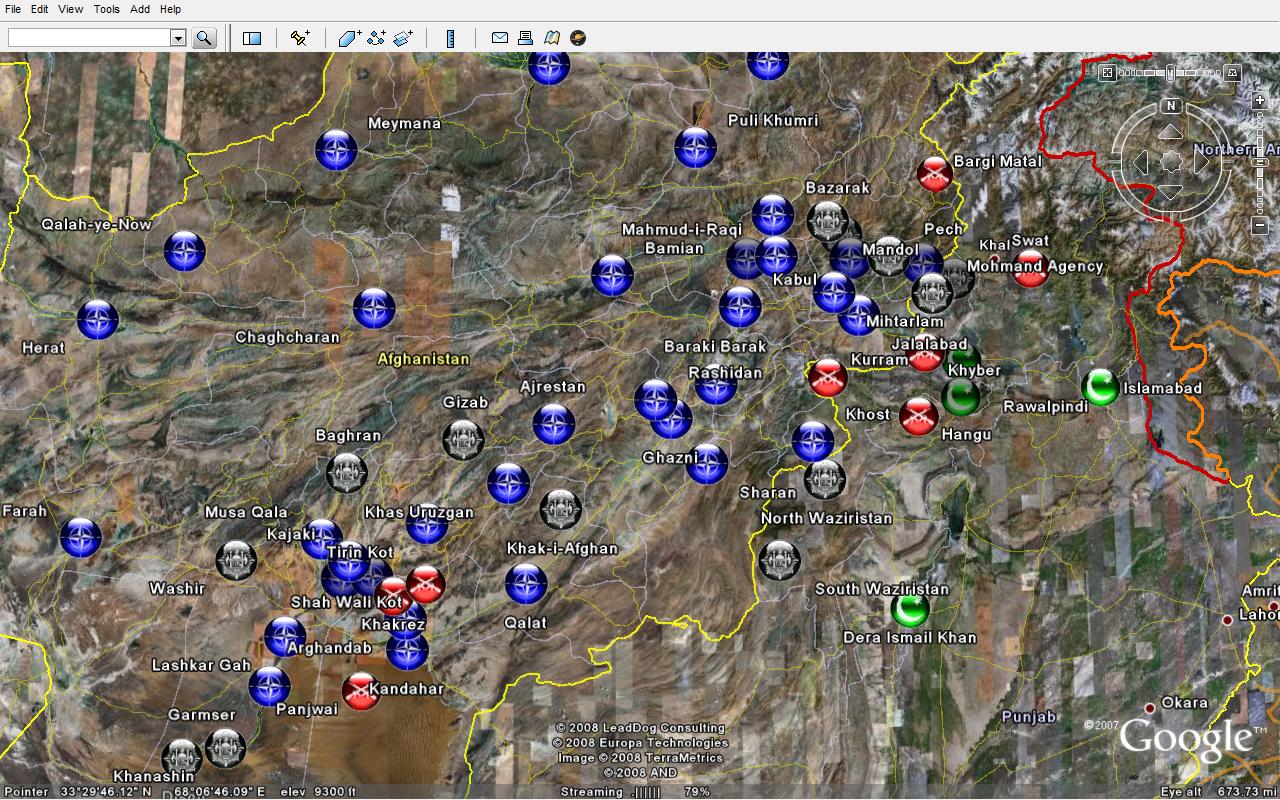 Finally.
This is a provisional map of who controls which districts in Afghanistan, as of 26 July 2008. The blue icons indicate control by NATO, the United States, and/or the central Afghan government. In order to avoid clutter (and crashing Google Earth), not all of these districts are shown; those that are shown are typically provincial capitals (especially those with Provincial Reconstruction Teams) or districts that the Taliban had controlled in the past. The black icons indicate districts and (and tribal agencies) held by the either the Islamic Emirate of Afghanistan itself or the closely related Tehreek-e-Taliban-e-Pakistan. This set is to the best of my knowledge complete, but bear in mind that this map is a rough draft. The green icons indicate districts and agencies that are held by Pakistan; obviously most such districts are not marked. The red icons indicate districts and agencies that are contested.
For the main image page on Flickr, click here.
Saturday, July 26, 2008
Pakistani Taliban swarm into remote district
14 July 2008
Comment:
This means that the Taliban now potentially controls at least three of Nuristan's eight districts, as well as the district of Pech in neighboring Kunar province (which has apparently still not been retaken). It is good that the Nuristanis are (or at least have been) resisting, but still, this is very, very bad.
Clashes come days after official says Nuristan may fall into rebel hands
A GROUP of Pakistani Taliban have crossed over the Afghan border and attacked a remote district in the north-eastern province of Nuristan, the Interior Ministry said.
The fighting, which began on Saturday, came days after the head of the provincial council warned that the entire province could fall into Taliban hands unless the government sent troops to stave off the Taliban assault in the Baga Matal district.
Five militants were killed and seven injured in the heavy fighting between police and Pakistani Taliban, the ministry said.
Extra troops have been sent into the district after several days of clashes, which saw residents take up arms against the rebels.
One of Nuristan’s Members of Parliament said the recent clashes had called into question the government’s ability to make swift, decisive decisions.
In the neighbouring province of Kunar, rebels killed nine US soldiers in one of the bloodiest attacks suffered by American troops since the US-led invasion of 2001.
Via Quqnoos.Comment:
This means that the Taliban now potentially controls at least three of Nuristan's eight districts, as well as the district of Pech in neighboring Kunar province (which has apparently still not been retaken). It is good that the Nuristanis are (or at least have been) resisting, but still, this is very, very bad.
Ajristan districit of Ghazni retaken by government
24 July 2008
Comment:
Specifically, it neighbors Gizab district, which is one of the Taliban's major strongholds.
The district in Ghazni which fell to Taliban recently is recaptured by Afghan government forces
Authorities in Ghazni province says that Ajristan district has been recaptured by Afghan forces.
The spokesman for Ghazni governor said that this district was taken on Wednesday during a joint Afghan and coalition operation and is once again under the control of the government.
According to the spokesman, 15 Taliban were killed and about 20 were wounded in the operation.
The Taliban captured Ajristan district 3 days ago. Ajristan is one of Ghazni’s remotest districts which neighbours Daykundi province.
Via Quqnoos.Comment:
Specifically, it neighbors Gizab district, which is one of the Taliban's major strongholds.
Thursday, July 24, 2008
Taliban fighters 'killed' in battle
Afghan army troops killed at least 34 Taliban fighters in a firefight after an army convoy was ambushed in the south of the country, a defence ministry spokesman said.
According to Zahir Azimi, the clash erupted after "enemy elements" attacked Afghan forces in Zabul province on the main highway between the capital Kabul and the southern city of Kandahar on Thursday. "A fierce battle started and the enemy were caught between the Afghan army on both sides," Azimi said.
"At least 34 enemy dead bodies are at the battlefield, but we believe there are many more killed." More Taliban fighters have reportedly been killed in a district that the anti-government group captured three days ago, a defence ministry spokesman said.
Afghan soldiers backed by Nato ground and air support launched an offensive in the remote Ajristan district of central Afghanistan's Ghazni province, killing at least 15 fighters, during an operation to retake control of the area, an Afghan official said on Thursday.
Ismail Jahangir, a government spokesman, said: "At least 15 Taliban have been killed and several others are wounded since [Wednesday]." The operation continued for a second day on Thursday, with the troops able to recapture the district headquarters compound but still fighting for wider control, Jahangir, a government spokesman said. The Nato-led International Security Assistance Force (Isaf) said: "The joint operations began with a co-ordinated air strike on Taliban fighters, inside Ajiristan. Several insurgents have been killed and wounded."
Remote districts
Ajiristan was previously captured by the Taliban in October 2007, and was retaken the following day when at least 300 security forces moved into the district centre.
The Taliban have captured several mainly remote districts in the past but have not been able to retain hold of them for long, although there are a handful in the southern Helmand province, that security forces admit are in rebel control.
The fighting in Afghanistan meanwhile continued to take its toll on international forces. In the latest loss, a British soldier was killed in southern Afghanistan, the UK defence ministry said on Wednesday.
A ministry spokesman said no further details were immediately available.
Via Al Jazeera.
Comment:
Al Jazeera does not appear to have even mentioned this district's fall. This is what I'm talking about when I call Afghanistan "the forgotten war".
As for AJ's statements about where the Taliban holds districts, it is true that Helmand has more than any other province, but at least half of the Taliban's districts are nonetheless in other parts of the country. I hope to have at least a rough draft of the map I've been working on available later today.
According to Zahir Azimi, the clash erupted after "enemy elements" attacked Afghan forces in Zabul province on the main highway between the capital Kabul and the southern city of Kandahar on Thursday. "A fierce battle started and the enemy were caught between the Afghan army on both sides," Azimi said.
"At least 34 enemy dead bodies are at the battlefield, but we believe there are many more killed." More Taliban fighters have reportedly been killed in a district that the anti-government group captured three days ago, a defence ministry spokesman said.
Afghan soldiers backed by Nato ground and air support launched an offensive in the remote Ajristan district of central Afghanistan's Ghazni province, killing at least 15 fighters, during an operation to retake control of the area, an Afghan official said on Thursday.
Ismail Jahangir, a government spokesman, said: "At least 15 Taliban have been killed and several others are wounded since [Wednesday]." The operation continued for a second day on Thursday, with the troops able to recapture the district headquarters compound but still fighting for wider control, Jahangir, a government spokesman said. The Nato-led International Security Assistance Force (Isaf) said: "The joint operations began with a co-ordinated air strike on Taliban fighters, inside Ajiristan. Several insurgents have been killed and wounded."
Remote districts
Ajiristan was previously captured by the Taliban in October 2007, and was retaken the following day when at least 300 security forces moved into the district centre.
The Taliban have captured several mainly remote districts in the past but have not been able to retain hold of them for long, although there are a handful in the southern Helmand province, that security forces admit are in rebel control.
The fighting in Afghanistan meanwhile continued to take its toll on international forces. In the latest loss, a British soldier was killed in southern Afghanistan, the UK defence ministry said on Wednesday.
A ministry spokesman said no further details were immediately available.
Via Al Jazeera.
Comment:
Al Jazeera does not appear to have even mentioned this district's fall. This is what I'm talking about when I call Afghanistan "the forgotten war".
As for AJ's statements about where the Taliban holds districts, it is true that Helmand has more than any other province, but at least half of the Taliban's districts are nonetheless in other parts of the country. I hope to have at least a rough draft of the map I've been working on available later today.
Wednesday, July 16, 2008
Taleban set up 'Pakistan courts'
Taleban militants in Pakistan's north-western Mohmand tribal area have set up permanent Islamic courts, they say.
The districts have been divided into four judicial zones, each having two judges and a permanent court address.
The Taleban have up until now used mobile courts - with no permanent offices or judges - to settle criminal and financial disputes.
They say the permanent courts show the diminishing authority of the central and local governments.
The Taleban currently control large areas of Pakistan's Federally Administered Tribal Areas (Fata) along the border with Afghanistan.
[More]Comment:
Strange how Pakistan objects so vehemently to our infringing on their sovereignty, but has no problem when the Taliban does it.
US Troops Leave Base Where 9 Died
KABUL, Afghanistan - U.S. and Afghan troops have abandoned a remote outpost in eastern Afghanistan where militants killed nine American Soldiers this week, officials said July 16.
Compounding the military setback, insurgents quickly seized the village of Wanat in Nuristan province after driving out the handful of police left behind to defend government offices, Afghan officials said.
Some 50 officers were headed to the area to try to regain control, said Ghoolam Farouq, a senior provincial police official.
The July 13 attack by some 200 militants armed with machine guns, rocket-propelled grenades and mortars was the deadliest for the U.S. military in Afghanistan in three years. Rebels fought their way into the newly established base, wounding another 15 Americans and suffering heavy casualties of their own, before the defenders and warplanes could drive them back.
The assault underlined how Islamic militants appear to be gaining strength nearly eight years after the ouster of the Taliban, and the difficulties facing foreign and Afghan forces trying to defeat them.
NATO said the post, which lies amid precipitous mountains close to the Pakistan border, had been vacated, but insisted that international and Afghan troops will "retain a strong presence in that area with patrolling and other means."
"We are committed, now more than ever, to establishing a secure environment that will allow even greater opportunities for development and a stronger Afghan governmental influence," NATO spokesman Capt. Mike Finney said.
Omar Sami, spokesman for the Nuristan provincial governor, said American and Afghan soldiers quit the base on July 15. He said they took the district mayor with them.
Sami said U.S. troops armed local police with more than 20 guns before they left, but that the officers had fled the village and crossed into neighboring Kunar province when 100 militants moved into Wanat.
Via Military.com, H/T Robrob.
Comment:
Great. Another black pin on the map. (I've been using blue and black placemarks in Google Earth to try to determine who controls what.)
I sure hope this is temporary.
Update:
Although Wanat is just a stone's throw from Nuristan, it's actually located in the Pech district of Kunar province (though it could be culturally Nuristani). My understanding is that not only Wanat, but also Dara-i-Pech (the district center) have fallen. Some sources indicate that reinforcements are en route to retake the district, or even that they already have retaken it, but there aren't enough for me to consider them credible (at least not yet). Also, it seems that this base was still under construction when the Taliban attacked.
Subscribe to:
Posts (Atom)